Key Takeaways
- The #1 reported scam is the Dürnstein Cruise-Crowd Restaurant Rush
- Most scams in Wachau Valley are low-to-medium risk
- Use app-based ride services (Uber, Bolt) or official metered taxis instead of unmarked vehicles
- Never accept unsolicited offers from strangers near tourist sites in Wachau Valley
⚡ Quick Safety Tips
- Eat away from the cruise window — groups all arrive together, so come before 11am or after 2pm
- Book direct from ddsg-blue-danube.at or brandner.at and board only that line's ships
- Buy jam, schnapps, and wine straight from a named Winzer or Heuriger, not a generic stand
- If staying overnight in Dürnstein or Loiben, collect the free parking ticket at your accommodation
Jump to a Scam
- Medium The Dürnstein Cruise-Crowd Restaurant Rush
- Medium Wrong-Boat Ticket Between Krems and Melk
- Medium Dürnstein Parking Maze and App-Only Trap
- Low Fake "Homemade" Marille Jam and Roadside Wine
- Low Melk Abbey Reseller Markup and Closing-Time Trap
- Medium Euronet ATM and Currency-Conversion Trap in Krems and Melk
The 6 Scams
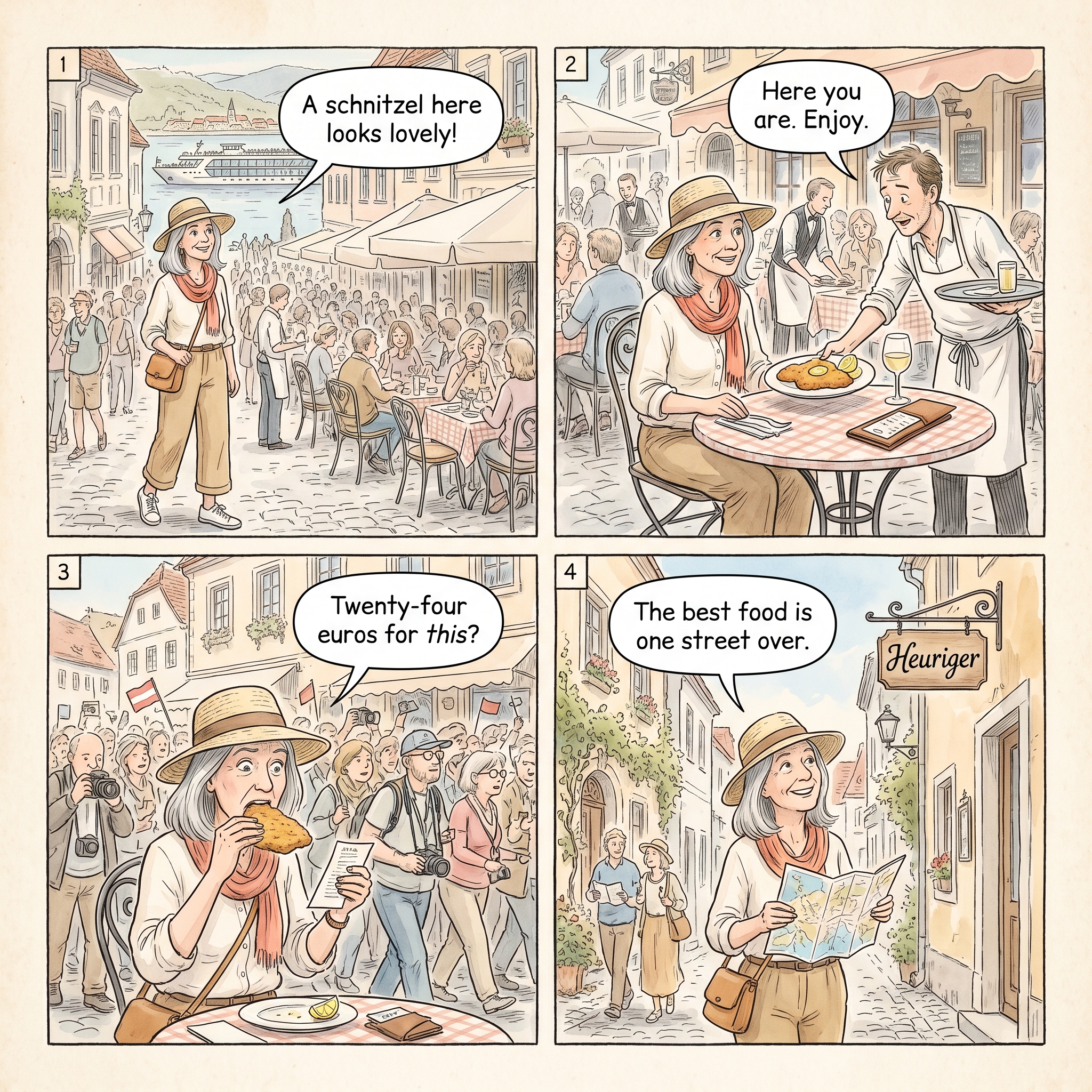
You sit down at a terrace on Dürnstein's one narrow Hauptstraße, order the Wiener schnitzel and a glass of Grüner Veltliner.
Twenty minutes later you are handed a microwaved plate, a curt server, and a bill that feels steep for what arrived. It is not bad luck.
Dürnstein is a town of roughly 200 residents that absorbs close to a million tourists a year, about 380,000 of them off Danube river cruise ships, and on a busy day up to 1,000 people funnel through that single street in tour groups spaced ten minutes apart. The local innkeeper Markus Schmelz told ORF Niederösterreich the core problem plainly: 'All ships arrive at the same time,' and guests expect to be fed 'in five minutes.' Rick Steves calls Dürnstein 'a touristic flypaper of a town' lined with 'stores selling overpriced ice cream and apricot jam.'
The kitchens cope with the surge by pre-plating, cutting corners, and turning tables fast, so the places right on the tour-bus path are precisely the ones least set up to cook you a proper meal. Expect to pay 18 to 26 euros for a rushed schnitzel and 5 to 7 euros for a glass of wine you could buy by the bottle for less at the source. Nobody is technically defrauding you; you are just eating at the worst possible moment in the worst possible spot.
The fix is to step off the conveyor belt. Walk five minutes uphill away from the river and the abbey, or drive ten minutes upriver to Weißenkirchen, Joching, or Spitz, and eat at a family Heuriger or Gasthaus on the locals' schedule rather than the cruise schedule. The food is fresher, the wine comes from the vineyard behind the building, and the price is what Austrians actually pay.
Red Flags
- Restaurant sits directly on Dürnstein's main tour-group lane, packed at midday
- Food arrives suspiciously fast and tastes pre-plated or reheated
- Several cruise groups seated at once and rushed through together
- Glass-of-wine prices far above the bottle price sold nearby
- Curt, hurried service with no time to ask about the menu
How to Avoid
- Eat away from the cruise window — groups all arrive together, so come before 11am or after 2pm.
- Walk five minutes uphill off Hauptstraße, or drive to Weißenkirchen, Joching, or Spitz.
- Choose a family Heuriger or Gasthaus where the wine comes from the vineyard out back.
- Buy your Grüner Veltliner by the bottle at a Winzer instead of by the overpriced glass.
- Skip lunch in Dürnstein entirely and treat the town as a walk-through, not a meal stop.
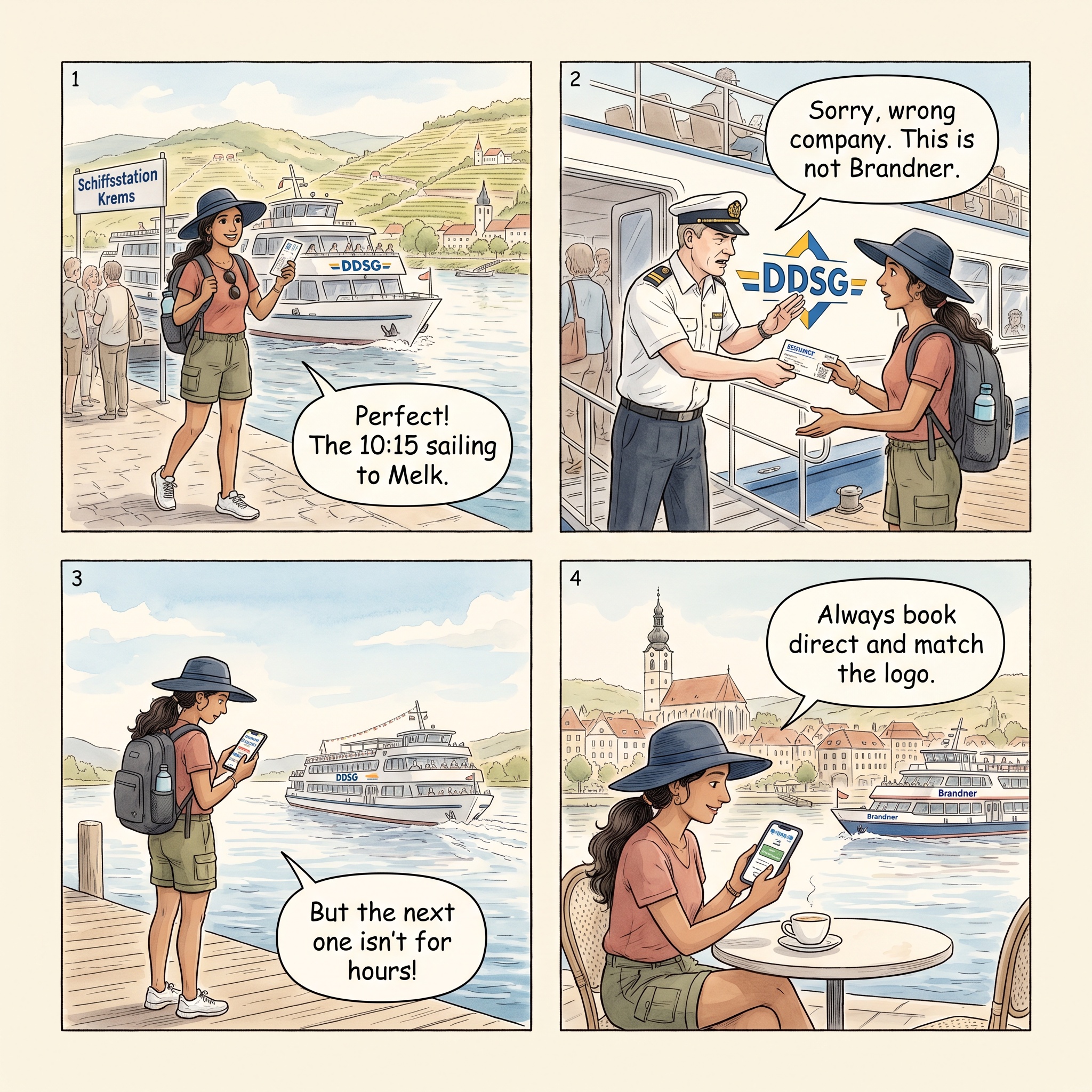
You buy a Wachau boat ticket from a kiosk near the Krems dock, walk to the gangway at departure time, and the crew waves you off because your ticket is for the other company's ship.
Two separate operators run the same scenic Krems-to-Melk stretch — DDSG Blue Danube and Brandner Schiffahrt — on similar but not identical timetables, and their tickets are not interchangeable.
One TripAdvisor reviewer described a crew checking the first passenger in the queue, announcing his ticket was 'from another ship company,' then closing the bridge and leaving with an almost empty boat; the next ship refused them too because they held the wrong operator's ticket.
The second trap is the timetable. From late March to late April and again from early October through early November, sailings drop to as few as three a day in each direction. Brandner riders have reported turning up to find a sailing simply not running and being shunted onto a later DDSG boat. One rider said it 'arrives at Melk almost two hours later.' A full-route ticket runs around 31 to 40 euros, so missing the last afternoon departure can strand you in Melk or Krems and force an expensive taxi or a scramble for the train.
Buy directly from one operator — ddsg-blue-danube.at or brandner.at — and ride only that company's ships. Note your specific departure time and dock, confirm the boat's name and logo before boarding, and in the shoulder seasons check the live schedule the morning of travel. The cheapest reliable backbone is the regional train along the river, which you can pair with a one-way boat segment via the ÖBB Wachau-Ticket combo.
Red Flags
- Two boat brands, DDSG and Brandner, share the Krems–Melk route on different schedules
- Kiosk or hotel sells you a ticket without saying which company's ship it is for
- Crew checks tickets at the gangway and turns away wrong-operator holders
- Shoulder-season sailings cut to three a day, easy to miss the last one
- Being told your scheduled sailing 'isn't running today' and pushed to a slower boat
How to Avoid
- Book direct from ddsg-blue-danube.at or brandner.at and board only that line's ships.
- Match the ship's name and logo to your ticket before you step on the gangway.
- In late March–April and Oct–Nov, check the live timetable the morning you travel.
- Note the last afternoon departure so you are not stranded after the final boat.
- Use the ÖBB Wachau-Ticket (train + one boat leg) as a flexible, reliable fallback.
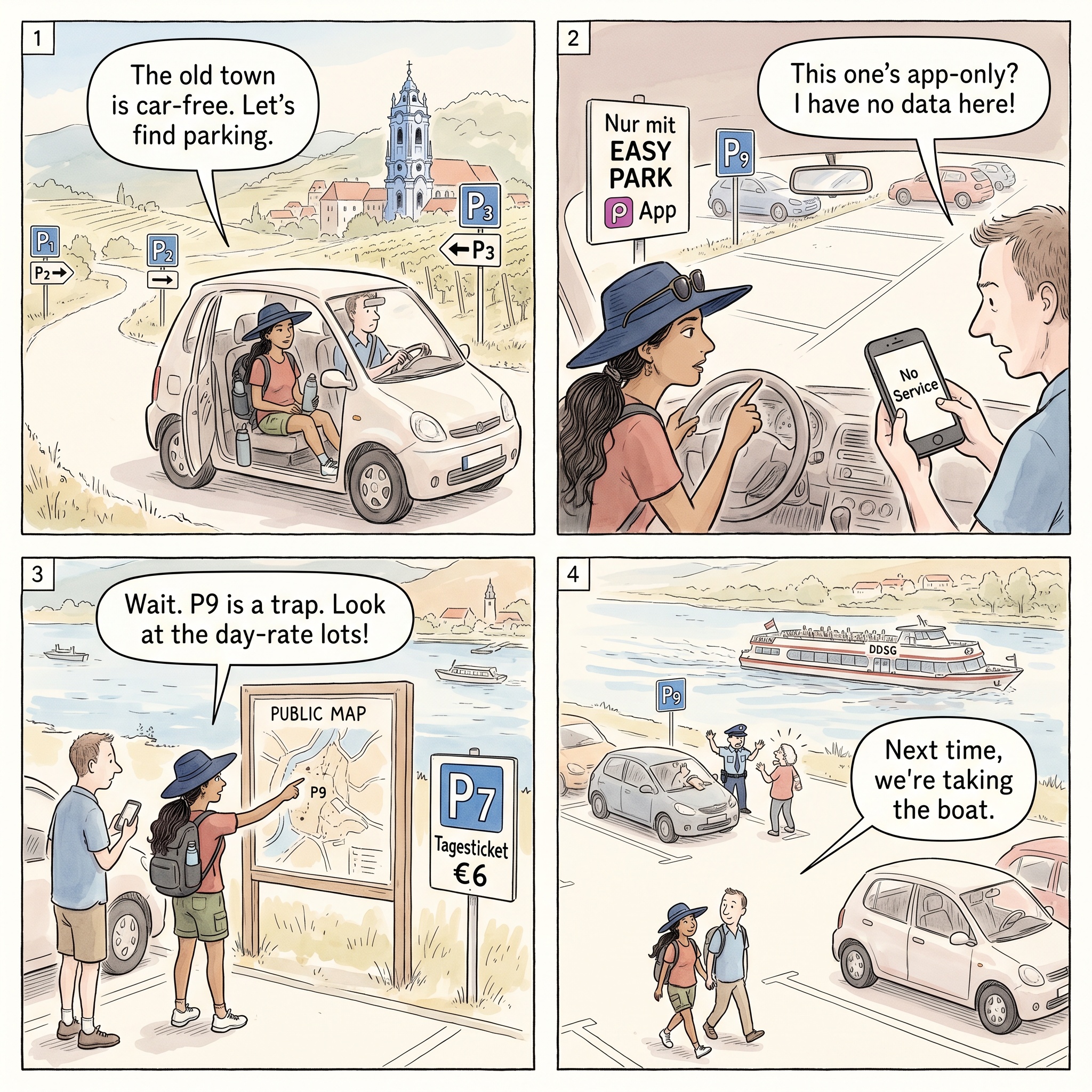
You drive into Dürnstein expecting to park near the famous blue-towered abbey and discover the medieval core is a no-car zone, so you are funneled into a ring of numbered pay lots.
P1, P2, P3, P6, P7, P8, P9 — with rates that quietly stack up. The main lots charge 2 euros for 30 minutes, climbing to 12 euros for a full day; lot P1 also handles tour buses at 35 euros for two hours or 70 euros for the day.
The catch most day-trippers miss is lot P9, the short-stay zone by the entrance. It takes 'mobile parking only' through the EASY PARK app, so without the app installed and a working data connection you cannot legally pay, and an unpaid stub on your windshield invites a ticket.
Dürnstein is not running a clamping racket, but the layout does the work of one on a confused visitor. People circle the lots, misjudge how long they'll stay, default to the priciest tier, or park in P9 unable to pay and come back to a fine. With nearly a million visitors funneling through a town of 200, the lots fill and the meters run.
If you are staying overnight in Dürnstein or Loiben, your guesthouse issues a free parking ticket — ask for it at check-in before you feed any machine. Day visitors should park in a flat-rate public lot (P4, P7, or P8 at 6 euros for the day) rather than the hourly P1–P3, and skip the app-only P9 unless you already run EASY PARK. Honestly, the calmest option is to leave the car behind and arrive by DDSG boat or regional train so parking never enters the equation.
Red Flags
- Old-town core is closed to cars, forcing you into numbered ring lots
- Hourly lots default you to the priciest tier if you stay 'just a bit longer'
- Lot P9 is mobile-payment-only via the EASY PARK app — no app, no legal payment
- Tour-bus parking in P1 runs up to 70 euros for the day
- Crowded lots tempt drivers into half-paid or no-ticket spots
How to Avoid
- If staying overnight in Dürnstein or Loiben, collect the free parking ticket at your accommodation.
- Day visitors should use a flat-rate lot (P4/P7/P8, ~6 euros all day), not the hourly P1–P3.
- Avoid app-only lot P9 unless EASY PARK is already installed and your data works.
- Pay the full expected duration up front rather than risking an under-paid stub.
- Skip the car entirely — arrive by DDSG boat or the regional train along the Danube.
Like what you're reading? Get a full Wachau Valley itinerary with safety tips built in.
Get Free Itinerary →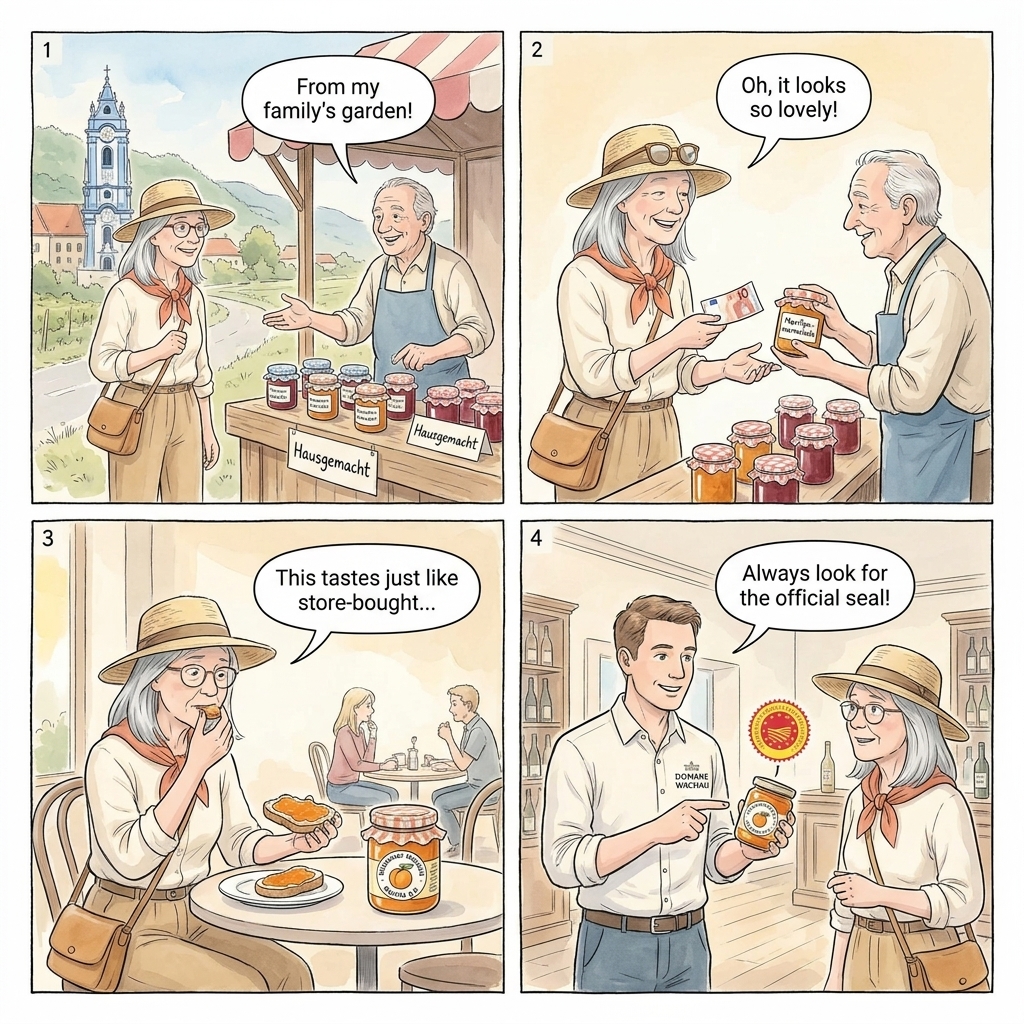
You pass a sunlit stand on the Wachau road or a souvenir shop in Dürnstein with handwritten signs promising 'hausgemacht' apricot jam and 'echter Wachauer' Marillenschnaps.
The jar you carry home turns out to be mass-produced, watered down, or made from apricots that never grew on a Wachau terrace.
The valley's apricot, the Wachauer Marille, carries an EU protected-origin seal precisely because the name sells. Because 'homemade' is not a regulated word, a generic supermarket conserve relabeled with a rustic checkered lid can run you 8 to 12 euros a jar, and a bottle of vaguely branded 'apricot schnapps' costs double what a real distiller charges. Rick Steves singles out Dürnstein's shops for their 'overpriced ice cream and apricot jam.'
The wine version is older than the apricot one. The Wachau's most legitimate growers band together under Vinea Wachau and the Domäne Wachau cooperative, which represents over 200 local wineries and forbids any adulteration or out-of-region grapes under its Codex. A roadside bottle with a generic 'Wachau' label and no producer, no Steinfeder/Federspiel/Smaragd category, and no Vinea Wachau mark may be neither homemade nor truly local.
Buy from the source. Genuine Wachauer Marille products and certified wines come straight from a named Winzer, a Heuriger, or the Domäne Wachau vinothek in Dürnstein, and authentic apricot goods carry the 'Wachauer Marille g.U.' protected-origin seal. If a stand can't tell you which orchard or estate the jar came from, treat the 'homemade' claim as decoration, not fact.
Red Flags
- Jars and bottles labeled 'hausgemacht' / 'echter Wachauer' with no named producer
- Apricot goods missing the 'Wachauer Marille g.U.' protected-origin seal
- Wine labeled only 'Wachau' with no Steinfeder/Federspiel/Smaragd category
- Generic souvenir-shop pricing of 8–12 euros for a small jar of jam
- Seller can't name the orchard or estate the product came from
How to Avoid
- Buy jam, schnapps, and wine straight from a named Winzer or Heuriger, not a generic stand.
- Look for the 'Wachauer Marille g.U.' EU protected-origin seal on apricot products.
- For wine, check for a Vinea Wachau mark and a Steinfeder/Federspiel/Smaragd category.
- Shop the Domäne Wachau vinothek in Dürnstein — a 200-grower cooperative with an anti-adulteration Codex.
- Ask which orchard or estate it's from; a vague answer means it isn't really homemade.
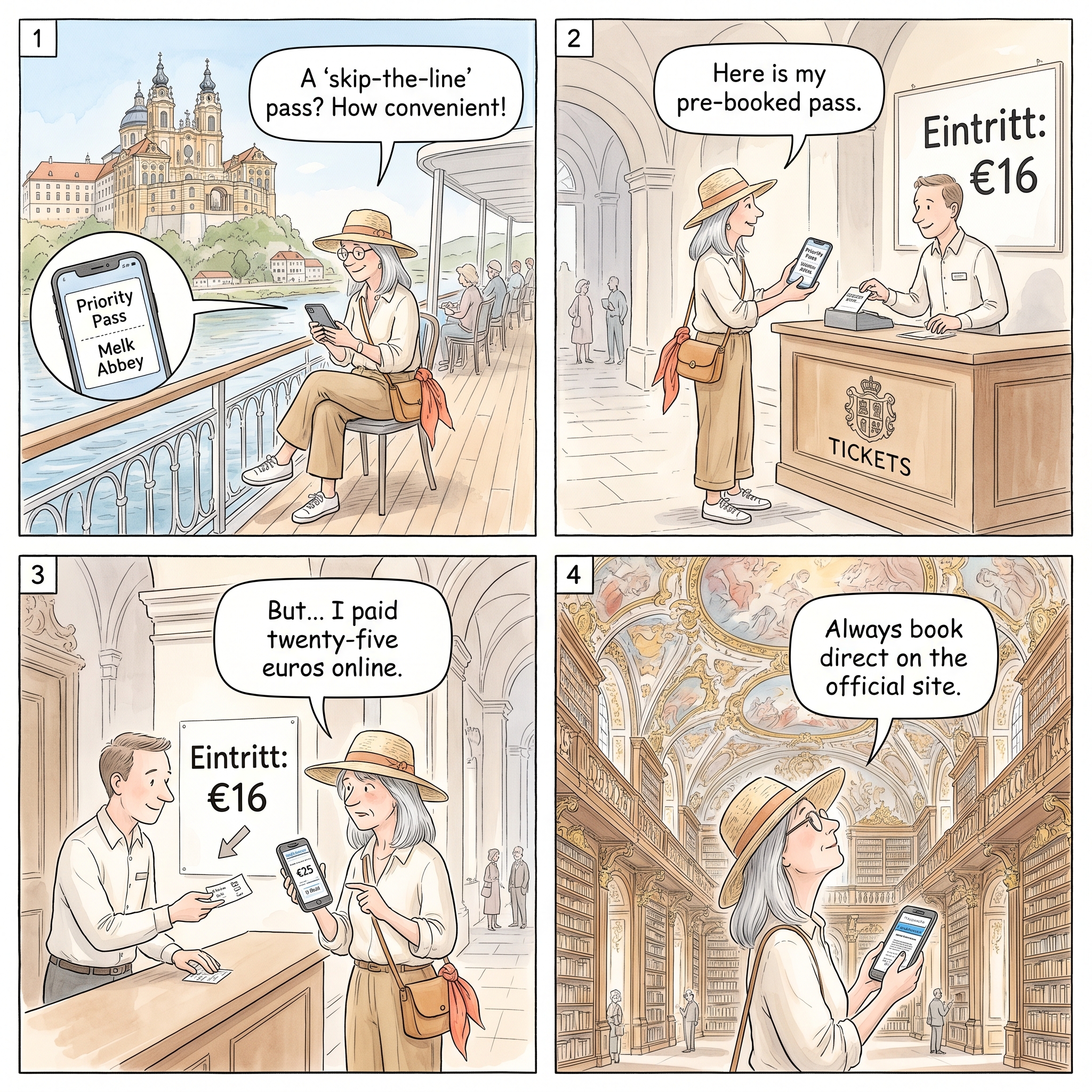
You search 'Melk Abbey skip the line' the night before, book a 'priority' ticket through a third-party site for what feels like a fair price.
Only at the gate do you realize you paid a markup over the abbey's own counter. Stift Melk sells adult admission directly for 16 euros, with an optional guided-tour supplement of 4 euros and a family ticket at 32 euros, all bookable on stiftmelk.at.
Reseller platforms like Viator and GetYourGuide bundle the same entry into 'skip-the-line' packages at a premium; the abbey rarely has a line long enough to need skipping, so the extra fee buys convenience that mostly isn't necessary.
The more costly mistake is timing. From April to October the abbey closes at 5:30pm but stops admitting visitors at 5:00pm, and in the shoulder days it shuts at 4:30pm with last entry at 4:00pm. From November into early March it runs guided tours only at fixed times — roughly 11am, 1:30pm, and 3pm — so a winter day-tripper who ambles up at 2pm expecting to wander the baroque library and church can find the doors locked or the next tour long gone.
River-cruise passengers, herded off the boat on a tight turnaround, are especially prone to arriving inside the last-admission window and being turned away after the climb up to the abbey.
Buy your ticket on the official stiftmelk.at site, or simply pay the 16 euros at the counter on arrival. Check the day's last-admission time before you leave the boat or the parking lot, and in winter book onto one of the fixed guided-tour slots in advance rather than gambling on walk-up entry.
Red Flags
- Third-party 'skip-the-line' Melk Abbey tickets priced above the 16-euro counter rate
- 'Priority access' sold for a queue that rarely exists
- Arriving after last admission (5:00pm summer, 4:00pm shoulder season)
- Winter visits with no awareness that entry is guided-tour-only at set times
- Cruise turnaround leaving too little time to reach the abbey before cutoff
How to Avoid
- Book on the official stiftmelk.at site or just pay 16 euros at the abbey counter.
- Skip paid 'skip-the-line' packages — the abbey rarely has a real queue.
- Check the day's last-admission time before leaving your boat or car (5:00pm in summer).
- In Nov–early March, reserve a fixed guided-tour slot (~11am, 1:30pm, 3pm) ahead of time.
- Add the 4-euro guided-tour supplement directly rather than overpaying a reseller bundle.
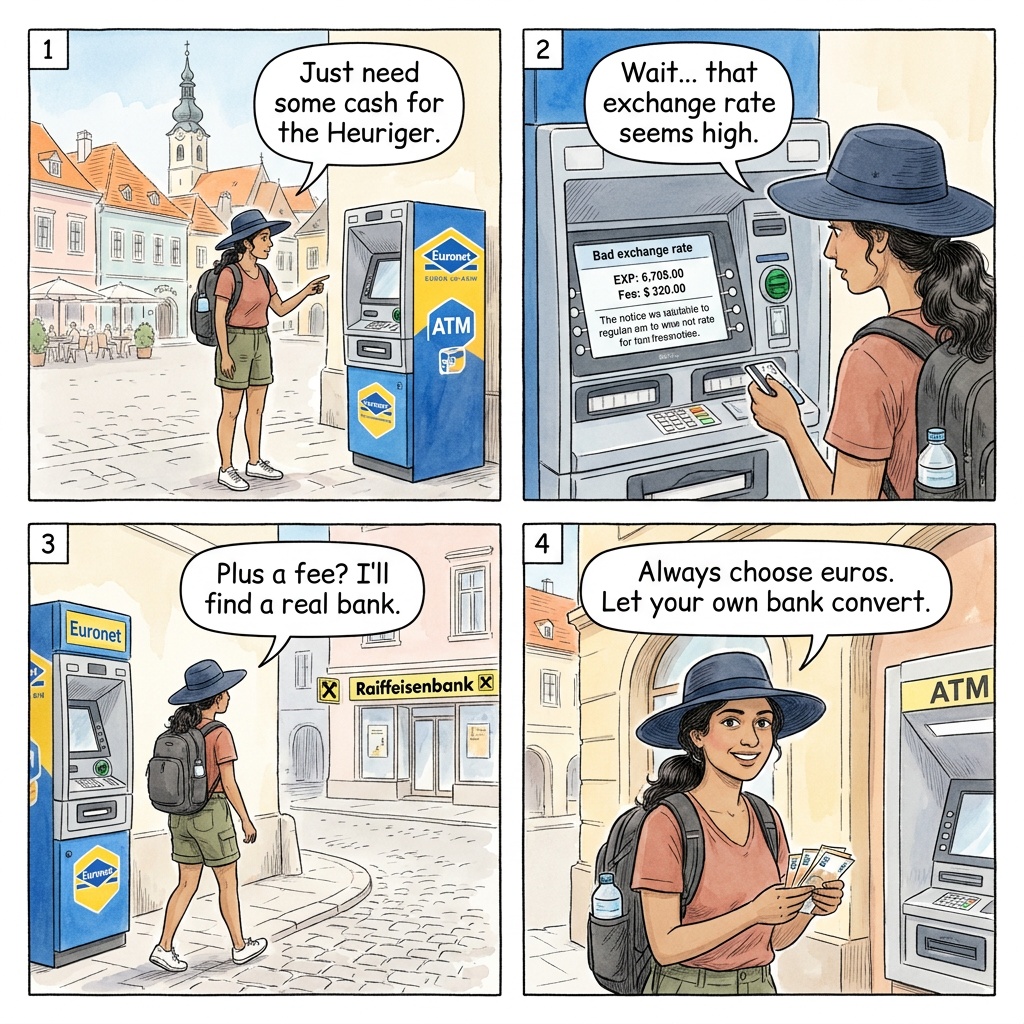
You need a little cash for the Heuriger or the parking machine, and spot a bright blue-and-yellow Euronet ATM near the Krems pedestrian zone or by the Melk dock.
The screen does two quiet things that cost you. First it adds a withdrawal fee — around 1.95 euros and often more — that a normal Austrian bank ATM would not.
Then it offers to bill you 'in your home currency,' the dynamic currency conversion pitch, with a friendly-looking locked-in rate that can carry a markup of up to 13 percent over the real interbank rate. Euronet runs roughly 190 of these machines in Austria, planted since 2016 in exactly the tourist spots where foreign cards show up, which is why they cluster near cruise stops like Krems and Melk rather than out in the villages.
Nothing here is illegal, but the defaults are engineered to extract the maximum. Tap the wrong button and a 200-euro withdrawal can quietly cost you 215 to 220, and the machine may also nudge you toward larger 'recommended' withdrawal amounts so the fee lands on a bigger sum.
When any ATM in the Wachau asks whether to charge in euros or your home currency, always choose euros and let your own bank do the conversion. Better still, skip the freestanding Euronet machines and use an ATM attached to a real Austrian bank — Raiffeisen (Raika), Erste/Sparkasse, or BAWAG branches in central Krems and Melk — where withdrawals are typically fee-free. Decline 'conversion' every time, and pull out enough cash in one go to avoid repeat fees.
Red Flags
- Bright blue-and-yellow standalone Euronet ATM near the Krems or Melk cruise zone
- Machine charges a withdrawal fee (~1.95 euros) a bank ATM wouldn't
- Screen offers to bill 'in your home currency' with a pre-set rate
- Suggested withdrawal amounts pushed higher than you wanted
- Sited in the tourist core, not where local bank ATMs are
How to Avoid
- Always choose to be charged in euros, never your home currency (decline DCC).
- Use a bank-branded ATM — Raiffeisen (Raika), Erste/Sparkasse, or BAWAG in central Krems/Melk.
- Avoid freestanding Euronet machines clustered near the docks.
- Withdraw a larger amount once rather than paying repeat per-use fees.
- Pay by card directly where accepted, again declining the home-currency option.
🆘 What to Do If You Get Scammed
📋 File a Police Report
Go to the nearest Austrian Federal Police (Bundespolizei) station. Call 133 (Police) or 112 (Emergency). Get an official crime report — you'll need this for insurance claims. You can also report online at polizei.gv.at.
💳 Cancel Your Cards
Call your bank immediately. Most have 24/7 numbers on the back of the card (keep a photo saved separately). Block any suspicious transactions before the thieves use your details.
🛂 Lost Passport?
Contact your nearest embassy or consulate. The US Embassy in Vienna is at Boltzmanngasse 16, 1090 Vienna. For emergencies: +43 1-31339-0.
📱 Track Your Device
If your phone was stolen, use Find My (iPhone) or Find My Device (Android) from another device. Don't confront thieves yourself — share the location with police instead.
Frequently Asked Questions
Ready to Plan Your Wachau Valley Trip?
Now you know what to watch for. Get a custom Wachau Valley itinerary with local tips, hidden spots, and restaurant picks — free.
Plan Your Wachau Valley Trip →